
High-Fidelity Wraparound in PA: A Guide for Families

If you're raising a young person with complex behavioral health needs, you already know how exhausting the system can feel. The endless intake forms. Appointments with specialists who don't talk to each other. The plans written about your family instead of with your family. Many Pennsylvania parents describe it as a full-time job on top of the one they already have, and the weight of it is real.
Too often, traditional case management treats families as passengers rather than drivers. Decisions get handed down while services get bolted on. And when something isn't working, you're the one left to hold it all together.
There's a better way, and it has a name.
High-Fidelity Wraparound (HFW) is widely considered the gold-standard approach for youth with complex behavioral, emotional, and mental health needs. HFW builds a plan around your family - one grounded in your strengths, your culture, your goals, and the people who already know your child. It's collaborative by design, and it's built to help youth stay in their homes, schools, and communities rather than in restrictive out-of-home settings.
At Expert Community Care Management (ECCM), we bring High-Fidelity Wraparound to Pennsylvania communities with one clear goal: to walk alongside families until they have the means to lead the way themselves.
What Makes High-Fidelity Wraparound Different
The word "wraparound" gets used loosely. High-Fidelity Wraparound is a more specific term - a defined practice model with trained facilitators, a required team structure, and measurable standards to ensure it's being delivered correctly. The "high-fidelity" part isn't marketing. It simply means the model is being followed as designed, and that adherence is checked.
It's defined by partnership
HFW isn't a service you receive. It's a team you sit on, one you help assemble. Alongside your facilitator and any clinicians involved, the team includes the people you choose: a grandmother, a football coach, a youth pastor, or a neighbor who has been picking up your kid from practice for years. Your voice isn't gathered as input. It sets direction.
It's built for self-efficacy, not dependence
Most systems measure success by how well a family complies with a plan. HFW measures it by how capable a family becomes. The goal isn't only to resolve the current crisis. Instead, it's to build the confidence, skills, and relationships that reduce your dependency on formal systems. A team that becomes unnecessary is a team that worked.
It's designed for complexity
HFW is intended for youth whose needs cross multiple systems at once, including behavioral health, schools, child welfare, juvenile justice, and developmental disability services. If you've ever sat in a meeting where four agencies each had a different plan for your child, you already understand the problem HFW exists to solve. One team. One plan. Everyone in the same room.
The Roadmap: Four Phases
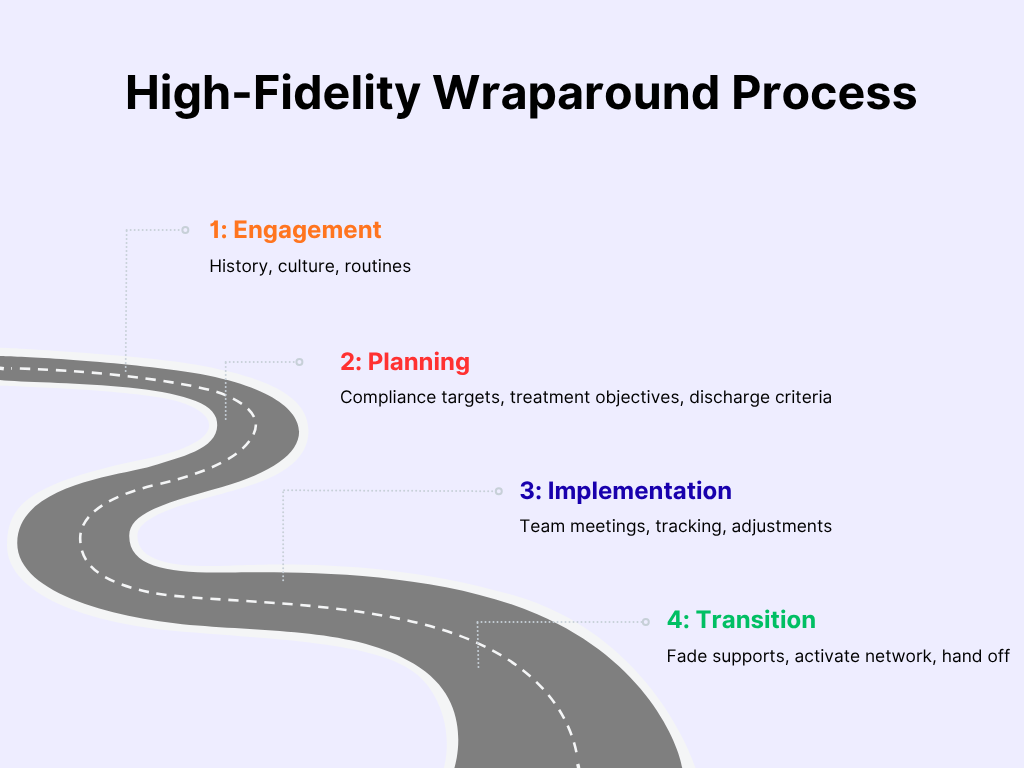
High-Fidelity Wraparound is a journey with a clear beginning, middle, and end. It's not indefinite. Knowing its shape up front makes the whole process less disorienting.
Phase 1: Engagement - Building the Foundation
Nothing useful happens without trust, so the first phase is spent earning it.
Your facilitator and support partners take time to learn who your family actually is: your history, your culture, your routines, what a good day looks like, what's already working that nobody's ever asked about. They also learn what hasn't worked, including which past providers or programs left a bad taste, and why.
This phase can feel slow if you're in crisis and want action immediately. But rest assured, it isn't wasted time. Every plan built later depends on how honestly this stage goes.
Phase 2: Planning - The Family Vision
Traditional planning starts with system goals - compliance targets, treatment objectives, and discharge criteria. HFW starts with your vision. What do you want life to look like in a year? Your team then works backward from that, translating your language into needs and strategies rather than the reverse.
You'll notice the difference in small ways. A goal stops reading "youth will comply with medication regimen" and starts reading "Marcus wants to make the varsity team, and staying regulated at practice is how he gets there." Same underlying work, but completely different ownership.
Phase 3: Implementation - Action and Adaptation
Now the plan moves.
The team meets regularly, tracks what's actually happening, and adjusts. This is where HFW's structure earns its keep, because life doesn't hold still. A parent loses a shift. A school placement changes. A strategy that worked in October stops working in January.
In many systems, a plan that stops working just… stays in the file. In HFW, the team is expected to notice, name it, and pivot. Progress is monitored against your goals, not against a checklist someone else wrote.
Phase 4: Transition - Graduation to Independence
This is the ultimate goal! As formal supports step back, natural supports step forward, from aunts to neighbors to church communities. Those relationships were deliberately built into the plan from Phase 1, precisely so they'd still be standing when the professionals leave.
It's a handoff to a network your family now owns.
The Power of Lived Experience: Youth Support Partners
If there's a secret ingredient in High-Fidelity Wraparound, it's the Youth Support Partner (YSP), a young adult who has been through the system themselves. They're trained, they're part of the team, and they bring something no credential produces: the ability to say I know and mean it literally.
A 16-year-old who has decided every adult in the building is against them will often shut down with a clinician. But with someone just a few years older who’s sat in the same chair? The child is far more likely to open up. This isn’t because the clinician is bad at their job; it’s because credibility works differently at that age.
The YSP's role isn't to be a buddy. It's to make sure the young person is an actual participant in their own plan, not a topic being discussed. This individual helps them name what they want, translates it into language the team can act on, and holds the team accountable for hearing it. When a young person believes the plan is partly theirs, resistance tends to drop.
Why This Model Works for Pennsylvania Families

It respects who you already are
Pennsylvania households don't look one way. Rural Warren County and the North Side of Pittsburgh are different worlds, and so are the families inside them - different faith traditions, languages, family structures, and ideas about what help should look like.
HFW is built to adapt to the family in this exact way. Cultural fit isn't a box the team checks at intake; it's a standard the plan gets measured against.
It's built to outlast us
Because HFW deliberately strengthens natural supports rather than substituting for them, the benefits don't disappear when the formal process ends.
The coach is still the coach. The aunt is still down the street. Families finish with something more durable than a service package: a network and the confidence to use it.
Take the Wheel on Wraparound with ECCM
High-Fidelity Wraparound is truly about reclaiming the story, about moving from crisis to confidence and from being managed to leading.
Whatever the paperwork says, you are the expert on your own family. You know your child's tells, their triggers, and the small things that turn a bad day around. A good team doesn't replace that knowledge, but organizes around it for person-centered progress.
Ready to learn more about how High-Fidelity Wraparound can support your child's journey? Contact our care team today, and we’ll explore which supports coordination services are a good fit for your family.